SubQuery Launches Hermes: A New Bittensor Subnet for AI-Powered Blockchain Data
Table of Contents
- Introduction: Bridging AI and Blockchain
- What is Hermes and Why It Matters
- Tokenomics and the Alpha Token Economy
- How Hermes Works
- Why Hermes is a Game-Changer for Web3 Applications
- Why SubQuery is Perfectly Positioned to Build the Hermes Subnet
- Conclusion
Introduction: Bridging AI and Blockchain
Artificial Intelligence (AI) and blockchain are reshaping technology as we know it. Today, we are thrilled to announce the launch of Hermes, SubQuery’s dedicated Bittensor subnet designed to bring AI and blockchain closer than ever. Hermes empowers developers to build smarter Web3 applications by connecting AI Agents directly to blockchain data, overcoming longstanding inefficiencies in cost and latency that have hindered the development of AI-native dApps.
A new wave of agentic AI is transforming industries, but web3 risks missing out. The current approach of using general-purpose LLMs (Large Language Models) for GraphQL agents creates prohibitive cost and latency, stifling innovation. To unlock this new era for our industry, we must solve these fundamental adoption barriers. Hermes changes that by introducing GraphQL Agents capable of automatically retrieving, analyzing, and responding to blockchain data in real time.
With Hermes, SubQuery takes a major step toward its vision of unlocking intelligence in blockchain data. Developers can now bring production-ready AI applications to life faster and for cheaper, while users benefit from smarter, faster, and more responsive blockchain experiences.
What is Hermes and Why It Matters
At its core, Hermes is designed to be a subnet of the Bittensor network, tailored for AI agents that handle blockchain data. These agents—like SubQuery’s GraphQL agent—act as translators between complex on-chain data and user-friendly applications. By rewarding miners and validators for their contributions, Hermes creates an ecosystem where AI agents continuously evolve to deliver better performance.
What makes Hermes unique is its focus on practical utility. Unlike generic AI experiments, Hermes targets real-world use cases by incentivizing AI agents that can power chatbots, trading assistants, governance tools, and automated support systems. This design ensures that improvements in Hermes lead directly to better Web3 applications, with tangible benefits for both developers and end users.
“Hermes is designed to connect AI innovation directly with real-world blockchain projects,” said Ian He, Chief Technical Officer at SubQuery. “By incentivizing continuous improvement, Hermes ensures that AI agents don’t just exist — they evolve, learn, and deliver real value to users.”
Benefits for Blockchain Developers
With Hermes, developers no longer need to spend weeks building complex data infrastructure. Instead of setting up heavy infrastructure to query blockchains, developers can leverage SubQuery or Subgraph indexers to accelerate their development process. From there, Hermes can empower these indexers with AI capabilities. This dramatically cuts development time and lowers costs, while improving scalability and reliability.
We’ve identified more than 50,000 Subgraph and SubQuery indexers built by developers across Web3. With Hermes, every one of these can be AI-supercharged — upgraded into GraphQL agents that understand, analyze, and respond to blockchain data intelligently.
As CoinDesk has noted, the combination of AI and blockchain represents one of the most promising frontiers in technology. Hermes is a real-world implementation of this vision—an accessible, incentivized platform where AI agents bridge the gap between raw blockchain data and user-friendly experiences.
Tokenomics and the Alpha Token Economy
The Hermes subnet operates on the Bittensor network and uses the Alpha token (SN82 Alpha) as its native utility token for all ecosystem activities.
How the SN82 Alpha Token Works
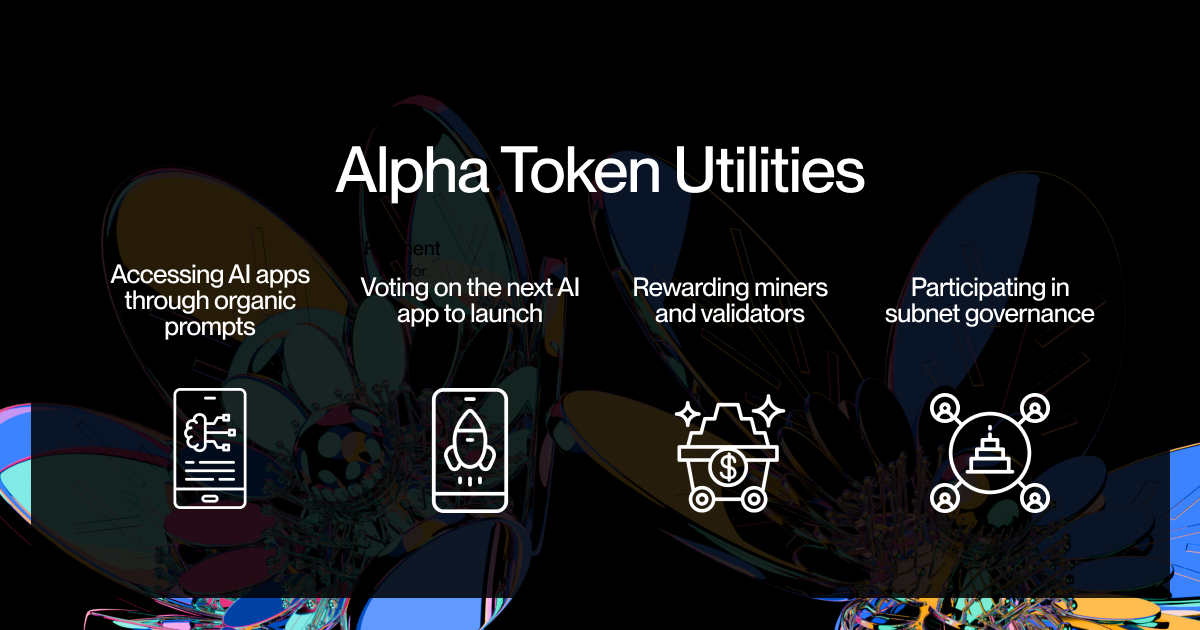
Alpha is obtained by staking $TAO on the Bittensor chain. When participants stake $TAO, they receive alpha in return — which can then be used throughout the Hermes ecosystem:
- Accessing AI apps through organic prompts
- Voting on which blockchain projects the subnet should prioritize
- Rewarding miners and validators for their contributions
- Participating in subnet governance
By tying rewards to performance, Hermes ensures that miners and validators remain motivated to provide accurate, fast, and useful AI-driven results. As demand for Hermes' AI services grows, the value and utility of the alpha token are expected to rise. This growth attracts more participants who need to stake TAO to engage with the subnet (e.g., as miners or validators), creating a virtuous cycle where increasing utility drives network security and participation.
How Hermes Works
Hermes isn’t just a concept - in short, we are building the specialized engine that will make GraphQL AI agents commercially viable to AI Agents.
What is GraphQL?
GraphQL is the cornerstone of Web3 because it provides a universal, efficient, and flexible way to query decentralized data across multiple blockchains and protocols. In an ecosystem where information is scattered and constantly evolving, GraphQL acts as a single, structured interface that lets developers and AI agents access exactly the data they need—no more, no less.
By creating a specialized, competitive ecosystem, we crowdsource the most efficient GraphQL solutions. Success means we can offer a product that is fast and cheap enough for customers to actually buy and use.
From Projects to Miner Rewards
The cycle begins when Authorized Callers or project owners submit GraphQL endpoints to the Hermes network, and vote these projects with the alpha token of Hermes to allow their projects to be selected. Validators then generate synthetic challenges—AI-generated prompts that test miners’ ability to compose graphql queries and interpret data accurately.
Miners, in turn, compete to answer these prompts with the highest accuracy, fastest response times, and most concise outputs. Their performance is scored against ground truth data and response time, with top-performing miners gaining higher rewards and opportunities to serve organic prompts from real-world users.
Cloud Mining and Accessibility
Looking ahead, Hermes plans to introduce cloud mining to further lower barriers to entry. This forthcoming feature will allow participants to contribute through shared cloud resources, eliminating the need for costly, dedicated hardware and enabling broader, more scalable network growth.
Why Hermes is a Game-Changer for Web3 Applications
Hermes is the bridge between AI and the data layer of Web3.
GraphQL is the backbone of blockchain data — it powers everything from DeFi protocols and DEXs to gaming, governance, and on-chain analytics. But today, AI can’t use this data efficiently.
For example, an AI agent connected to GraphQL could instantly:
- Fetch real-time trading pair prices and identify arbitrage opportunities
- Analyse historical wallet transactions to detect trends or risks
- Build personalized trading assistants that help users act on blockchain data in real time
Yet using large, general-purpose LLMs to achieve this is prohibitively expensive, slow, and inaccurate — blocking real adoption.
Hermes solves this. By connecting specialized AI agents directly to GraphQL and rewarding continuous improvements in speed, accuracy, and performance, Hermes makes intelligent blockchain data possible at scale.
Why SubQuery is Perfectly Positioned to Build the Hermes Subnet
SubQuery has been shaping how developers access blockchain data since 2021. As a leading Web3 data indexer, SubQuery powers thousands of dApps across 300 networks — from Solana, Polkadot and Cosmos to Ethereum and Avalanche. This experience in organizing and serving blockchain data makes SubQuery uniquely suited to build Hermes.
Hermes is the next step in SubQuery’s mission to unlock intelligence in blockchain data. After years of optimizing GraphQL infrastructure and decentralizing data services, SubQuery is now applying that expertise to connect blockchain data directly with AI.
By combining our expertise with Bittensor’s incentive model, SubQuery is building a network where AI agents can continuously learn, evolve, and deliver smarter, faster blockchain experiences.
Conclusion
Hermes represents more than just a new subnet—it’s a vision for the future of blockchain and AI working together. By combining SubQuery’s data indexing technology with Bittensor’s incentivized network, Hermes creates a thriving ecosystem where developers, miners, and users all benefit.
For blockchain developers, this means a faster path to building production-ready AI-driven Web3 applications. For businesses, it means scalable tools that improve governance, customer support, and user engagement. And for users, it means richer, more reliable interactions with Web3 technology.
👉 Ready to see how Hermes and SubQuery can power your next Web3 project? Start building with SubQuery today.
About SubQuery
SubQuery is building the foundational data layer of Web3 — open, scalable, and designed for the AI-driven future.
SubQuery Network provides decentralised data indexers and dRPCs that power thousands of dApps across nearly 300 networks. With AI-assisted tools in the SubQuery SDK and Model Context Protocol (MCP) integration, developers can easily build, deploy, and scale blockchain data infrastructure.
SubQuery Hermes (Subnet 82) is a Bittensor subnet that connects AI agents directly to blockchain data through GraphQL. By rewarding developers to create and improve these agents, Hermes enables intelligent on-chain applications.
AskSubQuery.xyz provides graphql query MCP as a service. It is also the first product to connect to Hermes Subnet as an Authorized Caller.
With SubQuery, you can unlock intelligence in blockchain data.
Linktree | Website | Discord | Telegram | Twitter | Blog | Medium | LinkedIn | YouTube
Share Post



Brittany Seales · Head of Marketing
You might also like
How Poor Indexing Can Create Blockchain Security Blind Spots
SubQuery Expands Consumer Rewards Programme to 100 Million $SQT with dRPCs
Indexers at a Crossroads: How AI is Transforming the Future of Web3
