Multi-Chain Perpetual Futures Indexing with SubQuery: A Case Study on Fufuture
Table of Contents
- Introduction
- The Challenge
- Issues Before Using SubQuery
- The Role of SubQuery in Fufuture
- Querying Fufuture Data in Plan English
- Benefits of Using SubQuery for Fufuture
- The Road Ahead
- Conclusion
Introduction
Fufuture is a decentralized, coin-margined perpetual futures exchange built for flexible and capital-efficient derivatives trading. By allowing traders to use crypto as margin, support any ERC20 token as collateral, and settle all positions fully on-chain, Fufuture delivers a truly composable perpetuals trading experience.
But delivering this experience at scale requires more than smart contracts - it requires reliable access to historical and real-time blockchain data across multiple networks.
To power its user-facing dashboard and trading history tools, Fufuture relies on SubQuery as the indexing foundation of its multi-chain data infrastructure.
Key Metrics at a Glance
- Active SubQuery Indexers: 5
- Primary Use Case: Customer dashboard and trading history views
- Hosting Partner: Managed SubQuery indexers via OnFinality’s hosting service
- Total Indexed Blocks: 151,000,000+
- API Requests Served (Monthly Avg.): 2,000,000+
- Average Query Latency: 249.47ms
- Uptime (Last 30 Days): 100%
The Challenge
As a perpetual futures exchange, Fufuture must give users fast and accurate access to the data that matters most in derivatives trading: complete trade and position history, detailed contract-level activity, robust account-level analytics, and transaction records that span multiple chains. All of this information exists on-chain, but querying raw blockchain data directly is simply not practical when building a seamless, real-time trading interface. Without a proper indexing layer, creating a responsive dashboard would mean investing in complex infrastructure, enduring slow query performance, and dealing with constant maintenance overhead - none of which aligns with delivering the smooth experience traders expect.
Issues Before Using SubQuery
Before adopting SubQuery, Fufuture ran into the same obstacles that many Web3 derivatives protocols face. At the time, there were very few genuinely viable indexing solutions available on the market. The team had previously worked with other indexing tools, but these solutions struggled to support a wide range of networks, making it difficult to scale alongside Fufuture’s multi-chain ambitions.
The alternatives that have appeared more recently often carry prohibitively high costs that don’t scale well for a growing protocol. On top of that, because Fufuture operates across several EVM-compatible networks, supporting multiple chains typically meant stitching together fragmented tooling, duplicating development effort, and risking inconsistencies across the stack.
For a fast-moving protocol that needs to stay agile while scaling across chains, the team required an indexing solution that could deliver strong performance, dependable uptime, and genuine cost-effectiveness - without forcing painful compromises on any of those fronts.
The Role of SubQuery in Fufuture
SubQuery plays a central role in Fufuture’s data stack, acting as the protocol’s core indexing and query layer.
Fufuture indexes data across multiple chains - primarily EVM ecosystems such as:
- BNB Chain
- opBNB
- Base
- Additional EVM-compatible networks
The indexed data is then used to power the customer dashboard available at: https://contractv2.fufuture.io/
Through this dashboard, users can:
- Trade perpetual futures
- View historical account activity
- Track contract interactions
- Explore detailed on-chain trading records
SubQuery enables this experience by transforming complex blockchain event data into structured, queryable datasets that can be served instantly in the front end.
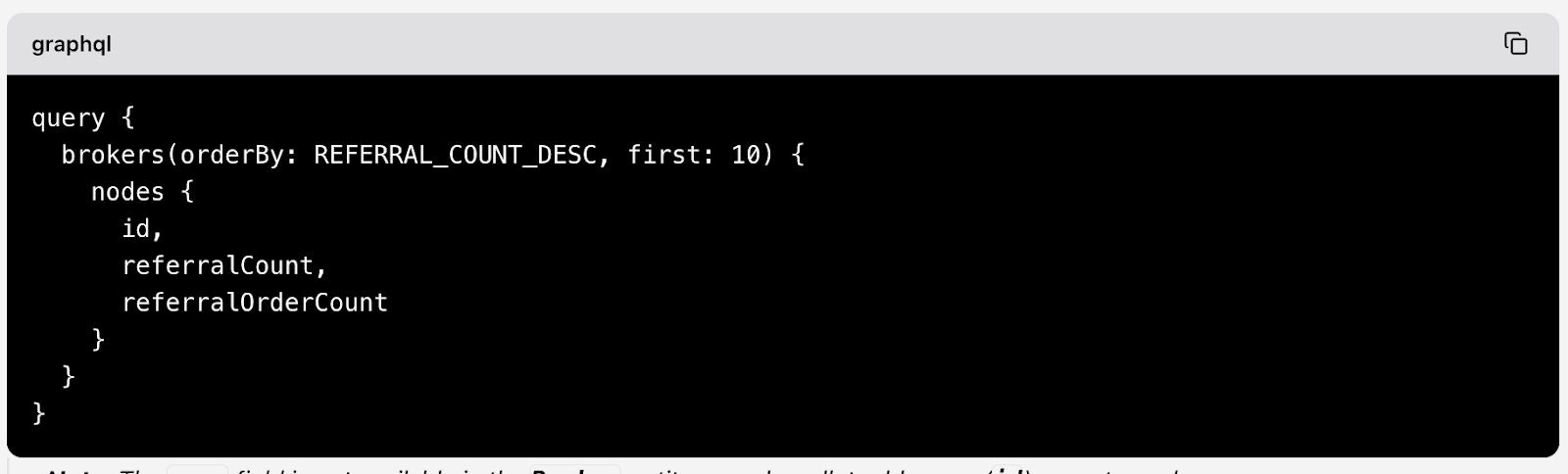
Below is an example query to obtain the top 10 brokers on Fufuture based on referral count:
Querying Fufuture Data in Plain English
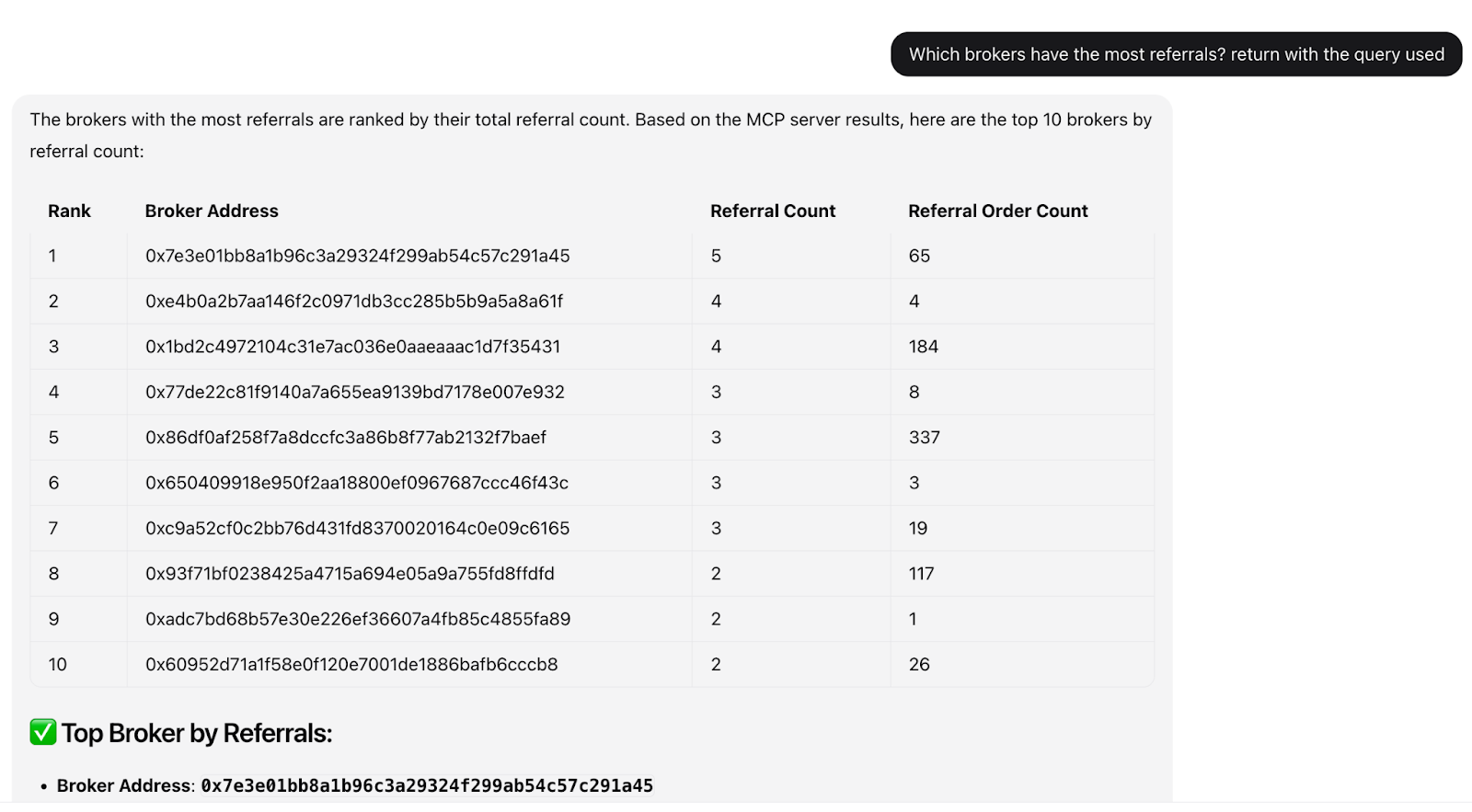
Beyond powering Fufuture’s on-chain derivatives infrastructure, the Fufuture SubQuery project can also be connected to AskSubQuery, allowing users to query the indexed Fufuture data using plain English. Instead of writing complex GraphQL queries, users can simply ask natural language questions such as:
“Which brokers have the most referrals?”
AskSubQuery translates the request into structured queries against Fufuture’s indexed dataset and returns formatted, actionable results in seconds: showing the top 10 brokers ranked by referral count, along with their respective referral numbers.
As shown in the example below, users can retrieve real-time referral leaderboard data across the decentralized brokerage system without needing to understand the underlying schema or blockchain structure.
This lowers the barrier to accessing onchain data, making Fufuture’s indexed datasets usable not just by developers, but by analysts, researchers, community managers, and even AI agents.
Benefits of Using SubQuery for Fufuture
For the Fufuture team, SubQuery has become the base layer of their system.
In their words:
“It’s easy to use and has multi-chain support. It is the base of our system, and we want it reliable.”
Key advantages include:
- Multi-chain indexing support across major EVM ecosystems
- Developer-friendly setup, making it easy to build and maintain
- Reliable structured data for dashboards and customer-facing analytics
- Scalability as Fufuture expands to additional networks
- Cost-effective alternative compared with newer expensive indexing providers
To ensure enterprise-grade performance, Fufuture runs its SubQuery projects through OnFinality, one of SubQuery’s trusted hosting partners, using a centralized managed service deployment.
This allows the team to focus on product development while maintaining reliable indexing infrastructure.
The Road Ahead
Fufuture continues to expand its multi-chain derivatives offering, with indexing playing a critical role in that growth.
As the protocol evolves, multi-chain support remains the most important factor in its data strategy. With activity already spanning multiple EVM networks (and plans to extend into Solana-like ecosystems) having a unified indexing layer is essential to maintaining a consistent and scalable user experience.
For the Fufuture team, this is where SubQuery stands out. Its ability to support multiple chains within a single framework is not just a feature, it’s a long-term advantage.
Looking ahead, Fufuture plans to:
- Expand beyond EVM into additional ecosystems
- Deploy indexing for Solana-compatible chains
- Enhance dashboard analytics and user-facing data tools
Conclusion
For decentralized perpetual exchanges, user experience depends heavily on fast access to accurate historical and real-time blockchain data.
By adopting SubQuery, Fufuture has built a robust multi-chain indexing pipeline that powers its trading dashboard, improves customer visibility, and supports expansion across ecosystems.
With SubQuery’s multi-chain support, ease of use, and enterprise hosting through OnFinality, Fufuture has established a reliable indexing foundation - enabling the protocol to focus on what matters most: building the future of on-chain derivatives trading.
Start building your SubQuery indexer
About Fufuture
Fufuture is a decentralized, coin-margined perpetual futures exchange.
Trade perpetuals using crypto as margin.
Support any ERC20 token as collateral.
All positions are settled on-chain.
Built for flexible, capital-efficient derivatives trading.
Website | Twitter | Medium | Gitbook
About SubQuery
SubQuery is building the foundational data layer of Web3 — open, scalable, and designed for the AI-driven future.
SubQuery Network provides decentralised data indexers and dRPCs that power thousands of dApps across nearly 300 networks. With AI-assisted tools in the SubQuery SDK and Model Context Protocol (MCP) integration, developers can easily build, deploy, and scale blockchain data infrastructure.
Hermes (Subnet 82) is a Bittensor subnet that connects AI agents directly to blockchain data through GraphQL. By rewarding developers to create and improve these agents, Hermes enables intelligent on-chain applications.
AskSubQuery.xyz provides graphql query MCP as a service. It is also the first product to connect to Hermes Subnet as an Authorized Caller.
With SubQuery, you can unlock intelligence in blockchain data.
Linktree | Website | Discord | Telegram | Twitter | Blog | Medium | LinkedIn | YouTube
Share Post



Brittany Seales · Head of Marketing
You might also like
Introducing AskSubQuery — AI That Answers Your Blockchain Questions
The Next Chapter for SubQuery
2025: The Year SubQuery Became the AI Data Layer for Web3
