5 AI Agents You Can Build with AskSubQuery
Table of Contents
- Why AI Agents Matter for Blockchain Data
- What Makes AskSubQuery Different
- AI Agent #1: On-Chain Analytics Assistant
- AI Agent #2: Web3 Product Insights Agent
- AI Agent #3: On-Chain Trading Agent
- AI Agent #4: Automated Support Agent for Web3 Apps
- AI Agent #5: Governance & DAO Intelligence Agent
- How This All Connects Back to SubQuery
- Start Building with AskSubQuery
Blockchain data is one of the richest open datasets in the world, but it’s also one of the hardest to work with. Schemas are complex, queries are verbose, and even experienced teams spend hours just trying to analyze blockchain activity.
AskSubQuery changes that.
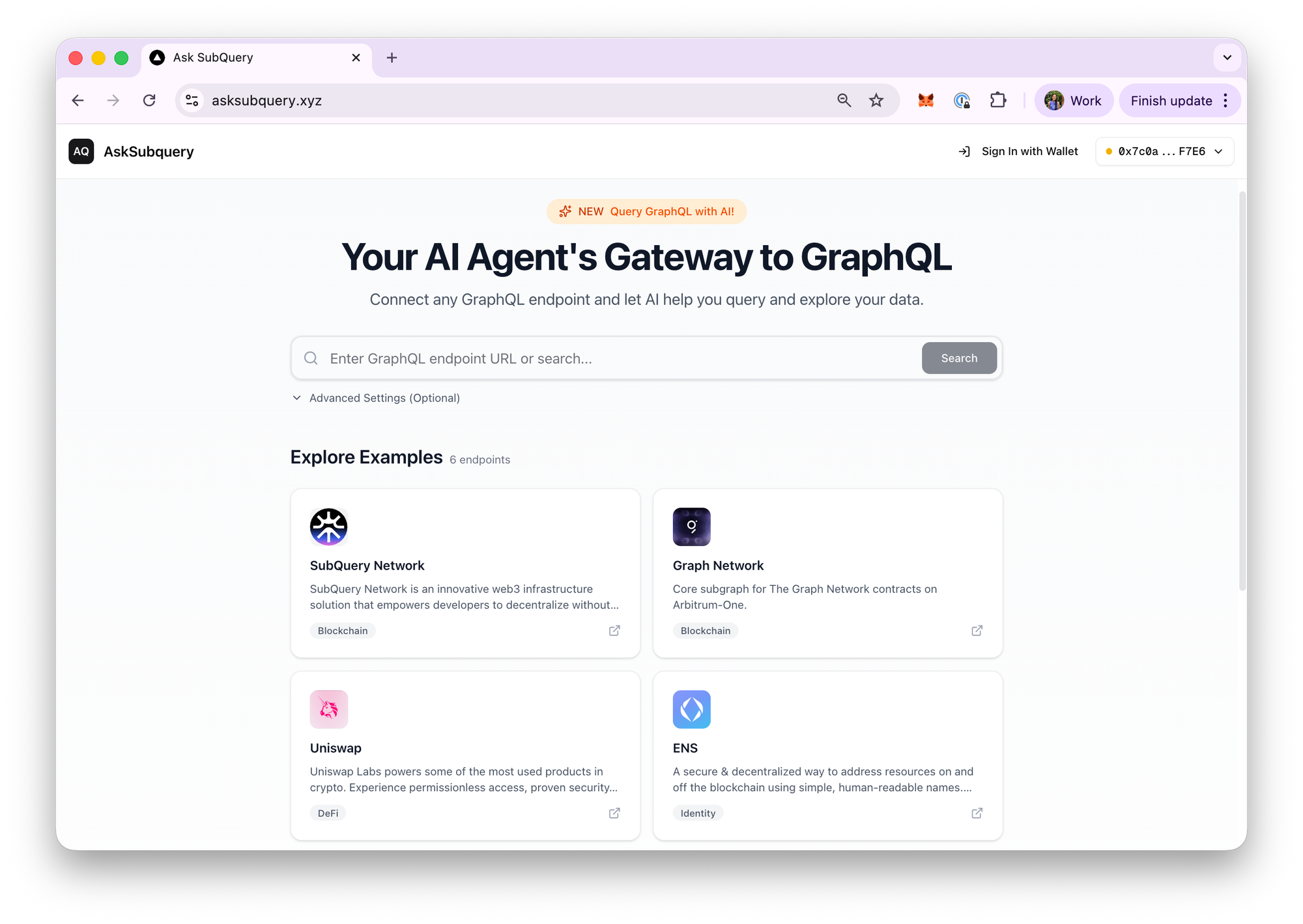
By turning natural language into production-ready GraphQL queries across SubQuery and The Graph, AskSubQuery makes it possible to build AI agents that understand blockchain data instead of just retrieving it.
AskSubQuery lets AI agents query blockchain data easily, but you still need a structured dataset (typically created using your own SubQuery project or subgraph) to provide the data the agents will analyze.
In this article, we’ll explore five practical AI agents you can build with AskSubQuery, and how they unlock faster blockchain development, smarter Web3 apps, and deeper on-chain insights.
Why AI Agents Matter for Blockchain Data
AI agents excel when they can:
- Interpret intent
- Query complex data systems
- Iterate quickly on results
Blockchain data fits AI agents perfectly - but only when those agents are trained to understand complex schemas and on-chain relationships. AskSubQuery benefits from this deeper intelligence through its integration with Hermes, a Bittensor subnet which ensures agents return fast, accurate, and reliable answers instead of shallow query results.
Traditionally, developers and analysts must understand indexing schemas, write GraphQL by hand, and manually stitch insights together. This slows down everything from protocol analytics to Web3 app development.
AskSubQuery removes that friction by letting AI agents reason over blockchain data using natural language, while still executing precise GraphQL queries under the hood.
What Makes AskSubQuery Different
AskSubQuery is powered by our GraphQLAgent MCP (Model Context Protocol) - the first AI-native querying layer built specifically for blockchain indexers.
It allows AI agents to:
- Automatically analyze schemas
- Generate valid GraphQL queries
- Execute them against SubQuery or The Graph
- Explain results in plain human language
This makes AskSubQuery an ideal foundation for AI agents that need to analyze blockchain data reliably and repeatedly.
For broader context on how GraphQL powers Web3 data access, check out this IBM explanation.
Note: While AskSubQuery simplifies the querying and integration process, it does not automatically index blockchain data. Developers must first create a SubQuery project or subgraph that indexes the blockchain data they want to analyze.
AI Agent #1: On-Chain Analytics Assistant
What it doesOnce you have your indexed SubQuery project or Subgraph with the relevant blockchain data, the agent can answer ad-hoc analytics questions in real time:
- “What wallets interacted with this contract last week?”
- “How has daily transaction volume changed since the upgrade?”
- “Who are the top users by activity this month?”
Why AskSubQuery is essentialInstead of pre-building dashboards or writing one-off queries, the agent uses AskSubQuery to translate each question into the correct GraphQL query instantly.
Who it’s for
- Analysts
- Founders
- DAOs
- Growth teams
This dramatically speeds up decision-making in blockchain development workflows.
AI Agent #2: Web3 Product Insights Agent
What it doesThis agent connects user behavior to product decisions:
- Which features are actually being used?
- Where are users dropping off?
- How do on-chain actions correlate with releases?
Why AskSubQuery is essentialAskSubQuery allows the agent to query your indexed dataset which can be across multiple endpoints, chains, and data sources - without requiring schema-specific logic for each one.
Who it’s for
- Web3 product managers
- Growth teams
- UX researchers
This unlocks a new class of data-driven Web3 apps that adapt based on real on-chain usage.
AI Agent #3: On-Chain Trading Agent
What it doesThis agent provides real-time, data-driven insights for trading and investment decisions by querying indexed on-chain market activity. It can answer questions like:
- Show me the top 10 tokens by large wallet accumulation over the past 24 hours.
- Are there any significant changes in DEX liquidity pool composition for this token pair?
- Identify any contract deployments or token minting events from this specific developer address.
- Which wallets are consistently profitable in their NFT flipping strategies, and what patterns do they follow?
When something changes, it asks follow-up questions automatically.
Why AskSubQuery is essentialInstead of maintaining separate query logic for each protocol (Uniswap, Curve, Aave, etc.), the agent can understand and explore relationships on the fly.
Who it’s for
- Retail and professional traders seeking an edge through on-chain analytics
- DAO treasury managers monitoring portfolio performance and market conditions
- Risk management teams detecting market manipulation or systemic risks
- Research analysts investigating token economics and holder behavior
NB: requires an indexed SubQuery project or Subgraph with the relevant blockchain data.
AI Agent #4: Automated Support Agent for Web3 Apps
What it doesThis agent acts as a first-line support assistant for Web3 apps, answering user questions like:
- “Why did my transaction fail?”
- “Where can I see my staking rewards?”
- “How do I interact with this contract?”
It queries indexed blockchain data to fetch relevant transactions, balances, or contract interactions and explains them in plain language.
Why AskSubQuery is essentialAskSubQuery allows the agent to translate user questions directly into GraphQL queries across indexed datasets, without hardcoded logic for every user flow or contract, unlike most support agent who can only answer from a static knowledge base.
Who it’s for
- Web3 apps
- Wallets
- Protocol frontends
- NFT marketplaces
This dramatically reduces support load while improving user experience.
AI Agent #5: Governance & DAO Intelligence Agent
What it does This agent helps DAOs and governance participants understand on-chain activity:
- “What is the current realized APY for our liquidity pool, and how has it trended?”
- “Which yield-generating proposals passed in the last quarter, and what was their impact?”
- “Which service providers (e.g., validators, node operators) are delivering the highest and most consistent returns for the protocol?”
By accessing indexed on-chain datasets -including financial performance metrics, proposal outcomes, and provider contribution data, the agent provides actionable insights. For example, it can analyze a specific stakeholder group's actual APY or their capital efficiency, and then recommend precise adjustments to relevant network parameters (like fees, incentives, or reward distribution) to optimize overall returns and sustainability.
Why AskSubQuery is essentialGovernance data is deeply relational. AskSubQuery’s schema-aware querying makes it easy for AI agents to explore these relationships without custom query engineering.
Who it’s for
- DAOs
- Delegates
- Token holders
- Governance tooling teams
How This All Connects Back to SubQuery
AskSubQuery is not a replacement for SubQuery (or The Graph) it’s an intelligence layer on top of it.
To use AskSubQuery effectively, you must first create a SubQuery project or subgraph to index the data your AI agents will query.
SubQuery and The Graph provide:
- High-performance, decentralized indexing
- Reliable blockchain data pipelines
- Cross-chain coverage
AskSubQuery adds:
- Natural language access
- AI-native querying
- Agent-friendly workflows
Together, they enable faster blockchain development, smarter Web3 apps, and entirely new ways to analyze blockchain data without increasing engineering overhead.
Start Building with AskSubQuery
AI agents are only as powerful as the data they can understand.
With AskSubQuery, you can stop fighting schemas and start building agents that reason, explore, and explain blockchain data in real time.
If you’re ready to:
- Build smarter AI agents
- Accelerate Web3 app development
- Unlock instant on-chain insights
👉 Ready to build AI-powered blockchain applications? Start by creating your SubQuery project or subgraph, then integrate it with AskSubQuery to unlock intelligent insights.
About SubQuery
SubQuery is building the foundational data layer of Web3 — open, scalable, and designed for the AI-driven future.
SubQuery Network provides decentralised data indexers and dRPCs that power thousands of dApps across nearly 300 networks. With AI-assisted tools in the SubQuery SDK and Model Context Protocol (MCP) integration, developers can easily build, deploy, and scale blockchain data infrastructure.SubQuery Hermes (Subnet 82) is a Bittensor subnet that connects AI agents directly to blockchain data through GraphQL. By rewarding developers to create and improve these agents, Hermes enables intelligent on-chain applications.AskSubQuery.xyz provides graphql query MCP as a service. It is also the first product to connect to Hermes Subnet as an Authorized Caller.
With SubQuery, you can unlock intelligence in blockchain data.
Linktree | Website | Discord | Telegram | Twitter | Blog | Medium | LinkedIn | YouTube
Share Post



Brittany Seales · Head of Marketing
You might also like
How Poor Indexing Can Create Blockchain Security Blind Spots
Choosing the Right Indexer for Multi-Chain Deployment
Blockchain Development in Regulated Industries: What’s Changing
